Begin with a behavioural description
Water measurements describe selected physical or chemical conditions. Behaviour describes how animals interact with the habitat. Swimming position, activity, shelter use and feeding response may add useful context, but none has a single explanation. A quiet animal may be resting, hiding, responding to light or experiencing a problem.
Start with what you can observe rather than a diagnosis. “Spent more time near the surface during the usual feeding period” is more useful than “the AI detected stress.” Note the species, usual routine, number of animals visible and any recent changes. Where possible, compare observations made under similar conditions.
Species-dependent context is essential. Surface use can be normal for some fish, and some animals are naturally difficult to see during daylight. An activity model trained on one species or tank design may misinterpret another. A baseline should describe the actual habitat, not an imagined average aquarium.
Understand what the image leaves out
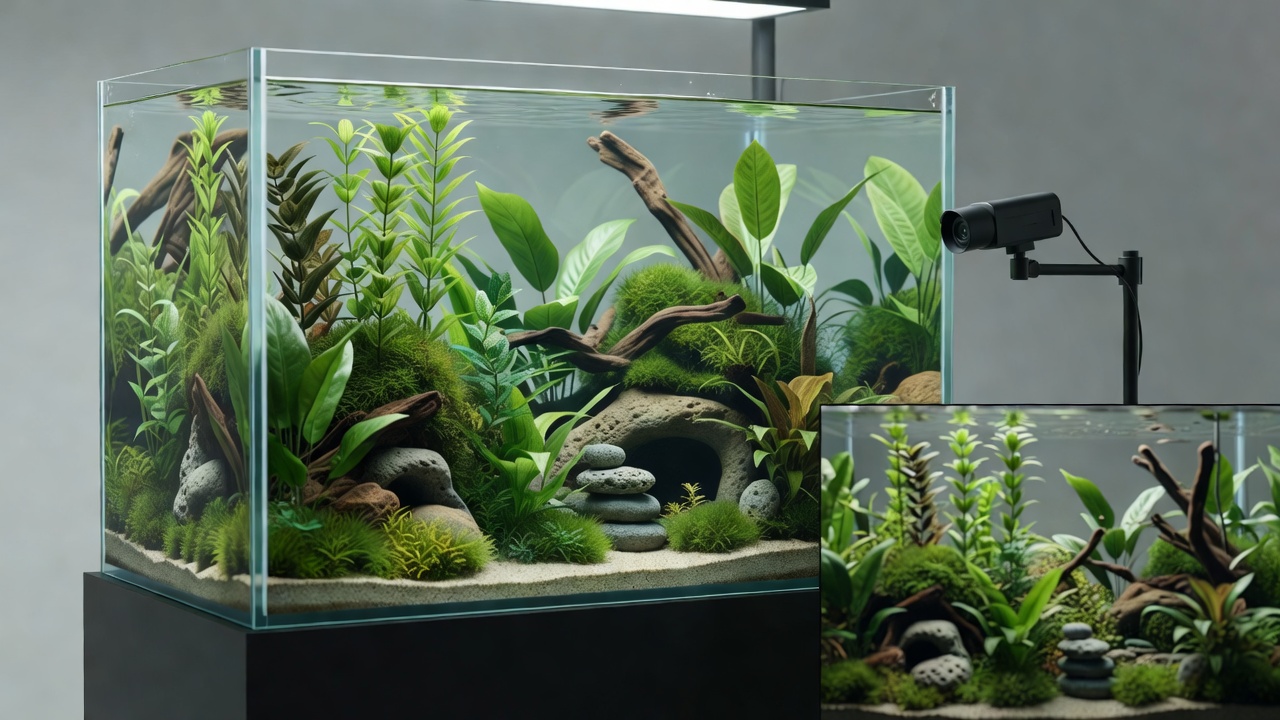
Plants, wood, rockwork and other animals can block the camera's view. Computer vision calls this occlusion. When a fish disappears behind a filter, its absence from the image is not evidence that it has stopped moving or left the aquarium. A counting system should distinguish “not detected” from “not present.”
Reflections can create apparent duplicates, while surface ripples and bubbles can generate moving shapes. Glare, algae on the glass and changes in exposure may alter an animal's apparent outline or colour. Automatic white balance can make a colour change look biological when it is mainly photographic.
Keep the camera position and lighting schedule consistent when comparing periods. Record lens cleaning or repositioning. Avoid adding unnecessary bright or continuous lighting simply to improve a model's images; husbandry needs come first. If observation requires disturbing the animals repeatedly, reconsider the monitoring method.
Separate detection, tracking and interpretation
Detection identifies likely objects in an image. Tracking attempts to connect detections over time. Behavioural interpretation then assigns meaning to those tracks or other visual features. Each stage introduces uncertainty. A model can draw a convincing box around a fish while still misidentifying it across consecutive frames.
Group behaviour makes individual tracking particularly difficult when similar-looking animals cross paths. A tracker may exchange identities, creating a false change in one animal's activity. Measurements such as speed also depend on frame rate, camera angle and scale. Pixel movement is not automatically a physical swimming speed.
Tools such as OpenCV and ImageJ support image processing and measurement, but using a recognised tool does not validate a particular aquarium application. Validation needs representative examples, clear labels and an evaluation that includes difficult scenes—not just the cleanest demonstration footage.
A useful observation record
- What was visible, and what was hidden?
- Was this a comparable time in the light and feeding cycle?
- Did the camera, glass clarity or exposure change?
- Did a person confirm the apparent behaviour?
- What independent water or equipment check adds context?
Combine evidence without forcing agreement
Imagine a camera flags reduced activity while temperature, pH and oxygen measurements remain near the established pattern. That disagreement is useful. Check visibility and lighting, inspect the animals directly and review whether the measured parameters cover the concern. Normal readings cannot exclude every husbandry or health problem.
The reverse also matters. An unusual oxygen trend deserves verification even when the visible animals appear ordinary. Behaviour may change later, be subtle or occur outside the frame. Neither a camera nor a probe should be granted automatic authority over the other. Look for an explanation that accounts for the whole record.
Do not treat an image classifier as a veterinary diagnosis. Similar external signs can have different causes, and many conditions require examination or tests that a camera cannot perform. If animals show persistent or concerning changes, seek qualified help and provide a factual timeline rather than an unverified model label.
Camera privacy deserves attention too. A view through aquarium glass can include people, rooms or reflections. On your own monitoring equipment, choose a narrow field of view, protect remote access and understand where recordings are stored. This educational website does not request camera access or receive aquarium footage.
Response example: the model counts fewer fish
Check shelters, visibility, reflections and the camera position. Compare several observation periods without repeatedly disturbing the tank. Verify the animals directly using an appropriate, low-disturbance method before treating the count as a real loss.
Sources and further context
- OpenCV documentation — image processing, detection and tracking concepts.
- ImageJ — scientific image-analysis tools and documentation.
- RSPCA fish welfare guidance — husbandry and welfare context.
- MSD Veterinary Manual — veterinary context for aquatic-animal health.